Books Your Kid Should Read

"I have always imagined that Paradise will be a kind of library." - Jorge Luis Borges

Blogger Template by Blogcrowds

Freckles

24 September 2008
Freckles
By Gene Stratton-Porter
Illus. Gene Stratton-Porter
1904

I inherited my copy of Freckles from my mom, who had supplemented the author's illustrations with a few of her own in the margins (really good ones, actually; she's quite the illustrator). I think she inherited the book from her mom - at any rate, the copy I have is quite old, from when the book was first published. I think I was nine or ten when I read it for the first time, and it immediately became one of my favorites. The writing style is unabashedly sentimental, full of heightened emotional reactions to the events that unfold. It's not a style that would be at all popular nowadays, but certain bookish pre-adolescents will eat it up. (And actually, I still enjoy the hell out of it.) The events take place in turn of the century Indiana, largely at a lumber camp preparing to take out some high value trees (oaks and other hardwoods) from a big swath of old-growth forest. Freckles, the title character, shows up at the camp one day looking for work. He's a half grown orphan, missing one hand, who knows nothing about his heritage and has a lot to prove. Since he obviously can't work at the camp itself, the manager, a Scot with a soft heart, takes a chance on giving him a job as Limberlost guard - the person responsible for watching over the parts of the forest that the camp hasn't yet begun to work. Freckles, urban to his core, has an uphill battle to navigate the raw nature of the Limberlost trail, but in the course of doing so he develops a deep interest in and love of nature, meets the love of his life, and ultimately discovers his roots. The story is steeped in naturalist's lore (the author was herself a noted naturalist and all-around interesting character) and while the environmental politics of the story are problematic by contemporary standards, the book also imparts a love of nature and a conservationist perspective that balances out the lumbercamp setting. It's also an excellent look back into midwest America at the turn of the twentieth century, with its blend of immigrant cultures, the deep contrasts between urban and rural life, and engaging characters from all social strata and both genders. Try it for free at Project Gutenberg.

All Creatures Great and Small

21 September 2008

All Creatures Great and Small
by James Herriot
1972

This is a perennial favorite in my library. I've probably re-read Herriot's books about ten times, and they never fail to make me laugh and cry out loud. All Creatures Great and Small chronicles the first years of Herriot's life as a country vet in the Yorkshire Dales, but it's a wonderful story even if you have no interest whatsoever in animals, Yorkshire, veterinarians, or country life. Herriot is a born storyteller, an acute observer of both human and animal character, with a gentle and self-effacing sense of humor that will win over even the most post-ironic hipster. This book and the four that follow it are WONDERFUL read-aloud books - the whole family will enjoy the stories, and Herriot's masterfully simple prose lends itself beautifully to the spoken voice. They're also great books for giving kids a sense of British life pre- and post-WWII, with the seizmic shifts that happened in social interactions, industrialization, and cultural norms. But it's the magical rendering of country life amid the characters - human and otherwise - of the Dales that will keep you coming back to this one again and again.

Also recommended: All Things Bright and Beautiful, All Things Wise and Wonderful, The Lord God Made Them All, and Every Living Thing.

Frog and Toad series

16 September 2008

Frog and Toad series
by Arnold Lobel
Illus. Arnold Lobel
1970-1979

My little sister and I used to act out the Frog and Toad stories sometimes. I was always Frog and she was always Toad. We practically had all the stories memorized from hearing them so often, and they're the perfect length for performing to grandparents and other favorable audiences. They're such simple tales, it's hard to put your finger on just what makes them so memorable. Part of it is the perfection of the illustrations, certainly. Another part of the attraction is the inimitable personalities of the two amphibian friends: Frog, amiable and easy-going; Toad, more serious and easily ruffled. Like real friends, they don't always agree with one another, but they always find a way to work things out in the end. The woodland setting of Frog and Toad's world evokes a gentle serenity that's balm to the parental soul, and the antics they get into will entertain kids from preschool into second grade. Great for beginning readers, but also wonderful for reading aloud.

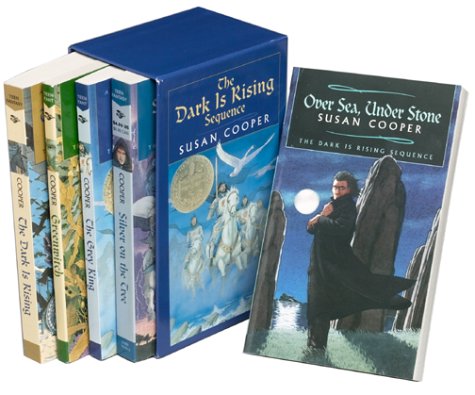
The Dark is Rising Sequence

12 September 2008

The Dark is Rising Sequence
By Susan Cooper
1965-77

I didn't stumble on The Dark is Rising sequence until I was a senior in high school, which is exceedingly odd if you know what my reading tastes were back then (and still are, if I'm being brutally honest). But it wasn't until I was living with my parents in Salzburg during the autumn of my senior year that I happened upon the books at the American Library. Desperate for some new leisure reading material (you can only pack so many books when you're traveling overseas for a semester), I took a chance on the books, and oh, how glad I am that I did! Cooper's books are firmly in the lineage of C.S. Lewis and J.R.R. Tolkein, but set in the late 60s and 70s, so a little more modern. They deal with all the classic british fantasy themes: Arthurian legend, the eternal fight between good and evil, the alliance of mortals with forces beyond mortal knowing, etc., etc. Your standard stuff. But wow, is the writing ever good. These books will transport you to the shores of Cornwall; to Welsh farm country; to the coziness of a British village in the depths of winter. Old traditions like the building of the greenman and the legend of Herne the Hunter are effortlessly threaded through the plot, grounding it in British folkloric tradition. The main characters are the three Drew children, caught up in the fight between dark and light through their "Uncle" Merriman (a loosely disguised Merlin character), and Will Stanton, an 11-year-old boy who discovers on his eleventh birthday that he is the last of the "Old Ones," mystical beings who possess great magical powers and fight for the light. Sure, sure, it can sound hokey if you're a jaded Gen-X formerly hip parental unit. But if you're an imaginative 11-18-year-old, this stuff is pure magic. A great option for kids who've gotten through Harry Potter and are looking for something in the same vein.

Little Bear

09 September 2008

Little Bear
by Else Holmelund Minarik
Illus. Maurice Sendak
1957

Ah, Little Bear. I think these were the first books I ever read to myself, when I finally learned to read at age 6. But I'd fallen for their charm quite a bit earlier. Minarik's simple stories of a bear, his family and his friends are enduring because of their classic themes of friendship, family, and imagination. The books are now a popular animated series on Noggin, but I hope it goes without saying that there's no comparison to the books. Minarik's lifelike rendering of Little Bear as a determined, inventive, outgoing young child will ring true to both parents and toddlers, and if the stories are old fashioned, it's only in the best sense of the word. Sendak's illustrations delightfully capture the ambiguously late-Victorian era of the tales (I believe the technical term for the setting would be "long ago" or "in olden times"), and overall the books are the kid's lit equivalent of snuggling up in a comfy chair with a nice cup of tea.

Also recommended: Father Bear Comes Home (1959), Little Bear's Friend (1960), Little Bear's Visit (1961), A Kiss For Little Bear (1968)

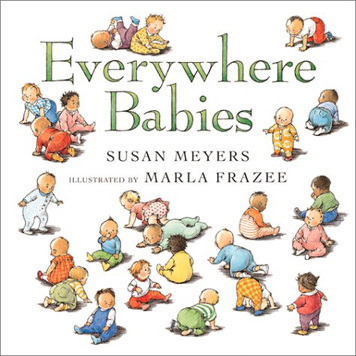
Everywhere Babies

08 September 2008

Everywhere Babies
by Susan Meyers
Illus. Marla Frazee
2001

This board book was just introduced to me by a friend, and I immediately loved it so much I had to put it on this site. Everywhere Babies is a simple rhyming book enumerating the many activites and accoutrements of the baby set, from how they get carried, to how they get fed, to how they play and make friends. The language is rhythmic and repetitive in a way that preschoolers and babies alike will find soothing (every day, everywhere babies are born, every day everywhere babies are carried, etc.), but as with many of the best board books, it's the illustrations that truly make this story special. Frazee's images are chock full of character and life, and she clearly knows her way around a baby. From the priceless expression on the face of the baby learning to walk to the true-to-life exhaustion of the breast-feeding mama, these pictures will ring true for the whole family - and each page is crammed with lots of activity. Even better, to this tree-hugging liberal mama's mind, is the wonderful diversity of families depicted in the book. Gay families, straight families, black and white families, multiple generations and single parents - they're all represented here, and in a way that celebrates different family arrangements without ever being preachy or PC. A wonderful, loving book that would be a great addition to any toddler's library.

On Break

01 September 2008
I know it's bad form to go on hiatus so soon after starting this blog, but I'm on vacation this week and my internet access is slim-to-none, so whaddyagonnado? Regular posting will resume on Sunday. Please consider this post an invitation to recommend your own favorite kid's books.

Ballet Shoes

28 August 2008

Ballet Shoes
by Noel Streatfeild
1936

If the only way you've ever heard of the Shoe books by Noel Streatfeild is from Meg Ryan's mention of them in You've Got Mail, boy have you been missing out. Ballet Shoes, the first of the books, is the story of Pauline, Petrova, and Posy Fossil, three orphans who are found and sent home to London as unusual souvenirs by Matthew Brown, an elderly and eccentric geologist. Pauline is a survivor of a shipwreck, Petrova is from Russia, and Posy arrives with only a pair of ballet shoes (her mother's) in her possession. The three are placed in the care of Matthew's niece, Sylvia, while he goes off on his endless travels. Soon enough the money runs out, and Sylvia must take in boarders and find a way to educate the three girls so they can care for themselves once they are of age. And so they are sent to The Children's Academy of Dancing and Stage Training, where Pauline quickly discovers her talent as an actress, Posy comes into her dancing heritage, and Petrova ... well, Petrova finds her own route. Streatfeild worked in the theatre for many years before becoming a writer, so the rendering of the training regimen, backstage life, and performing arts in general all ring true. This was one of the first books that gave me insight into the seriousness and legitimacy of a life in the arts - the rigor of it, the discipline, and the commitment it takes as well as the magic and joy it can confer. The three central characters are great role models, young women who take charge of their own destinies and are always there for each other despite disparate origins and very different personalities. And the rendition of 1930s London is vivid and memorable - a wonderful way for kids to enter into a different historical era. Many other Shoes books would follow (Theatre Shoes, Dancing Shoes, Party Shoes, Family Shoes, etc.), but I think it's always good to start at the beginning. (The books all have different settings and characters, but the Fossil girls have cameos in several of them.) It was also apparently made into a movie last year starring Emma Watson (Hermione Granger from the Harry Potter films) - which looks pretty good. But read the book first!

In The Night Kitchen

27 August 2008

In The Night Kitchen
by Maurice Sendak
Illus. Maurice Sendak
1970

A young boy, perhaps three years old, is in bed one night when he hears loud noises downstairs. Falling from his bed and out of his clothes, he mysteriously ends up in a surreal kitchen environment, peopled by three large chefs who bear a striking resemblance to Oliver Hardy. The chefs try to bake the boy into their cake batter, apparently mistaking him for the milk. The boy escapes, creates a plane from bread dough, and flies off to a ginormous milk bottle to get the requisite fluid. He pours the milk into the batter; the bakers finish making the cake; and the boy mysteriously finds himself back in his bed, back in his pajamas, with only the lingering memory of his night's adventure.

If In The Night Kitchen sounds like an extremely weird book, that's because, um, IT IS. Weird and wonderful in that way that only Maurice Sendak can completely pull off. The vivid dreamlike illustrations fill the page, with the text appearing in almost comic-book form, as part of the image rather than separate from it. And kids just EAT IT UP. The book has a history of controversy because Mickey (the boy) is naked in large parts of the book, and sometimes (gasp!) you can actually see his penis. It's a completely innocent and childlike representation, but apparently some people can't get over it, because it's consistently in the top 50 most challenged books. If you're easily offended by accurate (if cartoonish) representations of three-year-old anatomy, then this book maybe isn't for you. But for the rest of us, it's a weird, wonderful trip to the land of dreams.

Mrs. Piggle-Wiggle

26 August 2008

Mrs. Piggle-Wiggle
by Betty MacDonald
Illus. Hilary Knight
1947

Mrs. Piggle-Wiggle is the kind of old lady everyone wishes lived in their neighborhood. A kindred spirit to children everywhere, she lives in a magical upside-down house, there's buried treasure in her backyard, and her home always smells like freshly-baked cookies. The kids in her town know they'll always find a friendly face and comforting advice over at Mrs. Piggle-Wiggle's place, but it's their parents who are really in her debt. You see, Mrs. Piggle-Wiggle has a cure for just about any kind of bad habit or mischievous behavior a kid can get up to. Whether it's not wanting to bathe, staying up all hours of the night, or fighting with their siblings all the time, Mrs. Piggle-Wiggle knows a clever (and enormously fun to read about) way to get it to stop. The stories are presented from a kid's perspective, meaning that the adults (with the exception of Mrs. Piggle-Wiggle) often come off as amusingly dim. Each chapter is its own self-contained story, making this a perfect book for bedtime reading aloud (if you can stick to just one story, which is difficult). Though the stories are technically about behavior and etiquette, they're never moralistic or condescending. The true-to-life depictions of kids' tantrums and misbehavings, along with the highly unusual tactics recommended by Mrs. Piggle-Wiggle to cure them, make a compelling read even if you don't care a whit about manners and morals. And if they get your kid to think twice before pitching a fit at bedtime, so much the better. With really excellent illustrations by Hilary Knight (of Eloise fame).

Also recommended: Mrs. Piggle-Wiggle's Magic (1949), Mrs. Piggle-Wiggle's Farm (1954), and Hello, Mrs. Piggle-Wiggle (1957).